
Estate Dossier: Turning an AI-Generated Prototype Into a Product Foundation
AI can generate polished product concepts quickly. That does not mean the output is ready to build.
For Estate Dossier, an emerging platform for organizing the information, responsibilities, and workflows involved in managing a complex estate, I used AI-assisted tools to accelerate early product exploration. The real work was applying senior product-design judgment to determine what should move forward, what needed refinement, and what would create unnecessary user friction or technical debt if accepted at face value.
The result was a more focused, extensible V1 foundation—one designed to support sensitive information, multiple user roles, and a long-term product roadmap without overcomplicating the earliest release.
The challenge
Estate management is not conventional property management.
The product needs to help homeowners, family members, estate managers, household staff, and trusted service providers organize and act on a wide range of information: properties, documents, contacts, maintenance needs, assets, vendors, responsibilities, and decisions. That creates a high bar for clarity, permissions, information architecture, and workflow design.
Early prototyping in Lovable made it possible to move rapidly from product concepts to interactive screens. But the speed of AI-generated work introduced a familiar risk: reasonable-looking default patterns can conceal poor assumptions about user value, the underlying data model, security, and operational complexity.
My role was to evaluate the output against the intended product domain and roadmap, then refine the experience before early design choices hardened into product or implementation debt.
My role
I led product vision, information architecture, AI-assisted prototyping, design direction, roadmap alignment, and quality review.
My work included:
-
Defining product boundaries so Estate Dossier remained distinct from generic property-management software
-
Evaluating early AI-generated screens and workflows for actual user value
-
Shaping a V1 information architecture that could extend into the long-term roadmap
-
Simplifying relationships among people, accounts, contact information, roles, and permissions
-
Identifying where sensitive information and high-stakes workflows required additional care
-
Reducing unnecessary review and approval steps in the upload experience
-
Establishing a clearer foundation for future data schema and feature development
Tools used: Lovable, Claude Code, Perplexity, Figma, GitHub, Vercel.
The evaluation lens
I reviewed early concepts against four practical standards:
This made it possible to separate a good-looking prototype from a product that could actually be trusted, adopted, and extended.
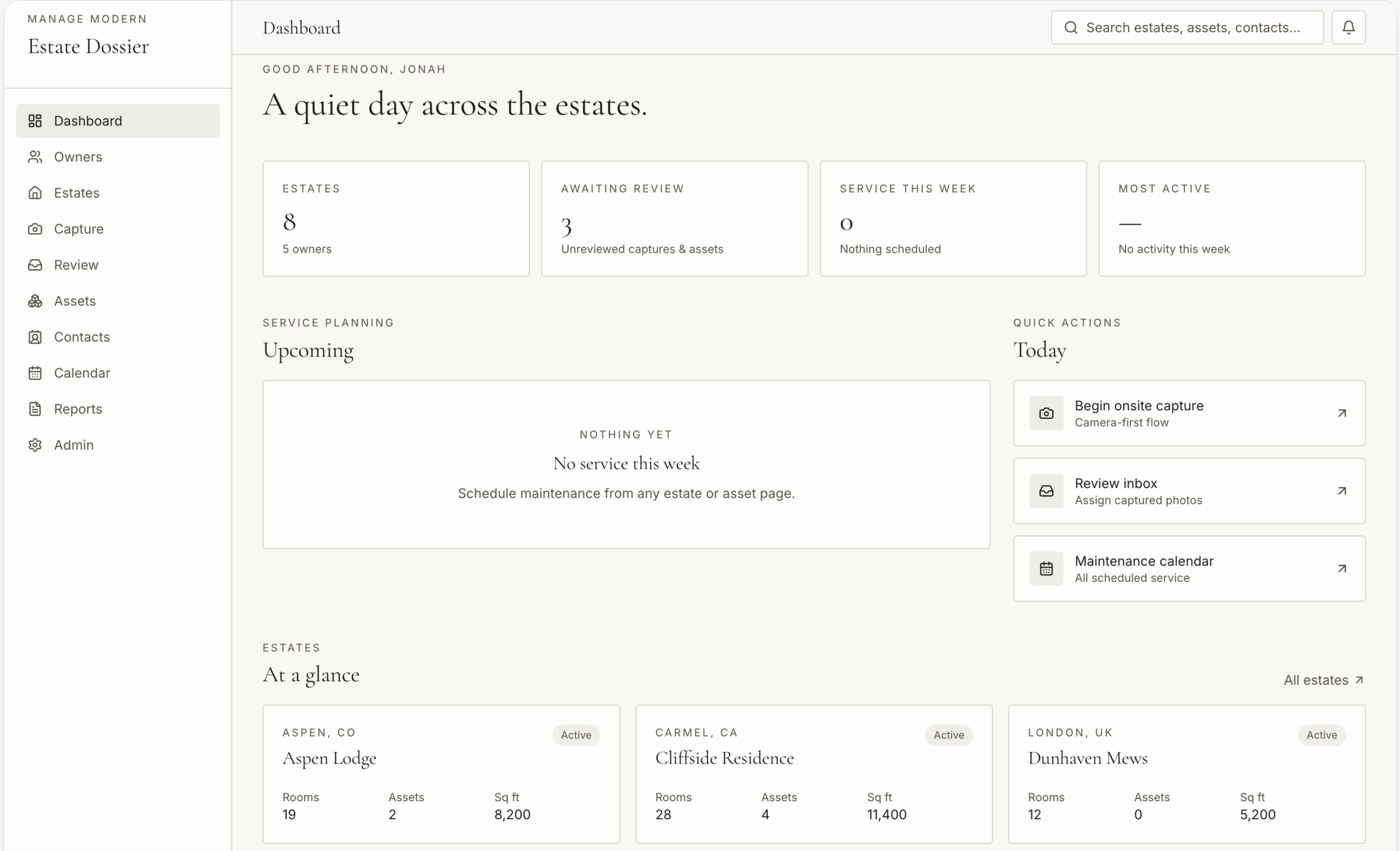
1. Replacing a data-rich dashboard with actionable priorities
One early AI-generated dashboard was visually polished. It used cards, charts, summaries, and activity highlights that created the impression of a comprehensive management platform.
The problem was that much of the information did not help the user make a decision or take action.
The interface elevated data because it was available—not because it was relevant. It risked creating cognitive load and making Estate Dossier feel like a generic dashboard rather than a reliable tool for managing an estate.
The issue
Severity: Major — Low-value information hierarchy
The dashboard highlighted information without connecting it to a meaningful decision, responsibility, risk, deadline, or next action.
The standard
Every top-level dashboard element should help answer at least one of these questions:
-
What needs my attention now?
-
What has changed?
-
What is at risk or overdue?
-
What decision is required?
-
What should happen next?
The correction
I reoriented the dashboard around actionable priorities:
-
Outstanding tasks and responsibilities
-
Meaningful changes to property, household, vendor, or document information
-
Deadlines and upcoming obligations
-
Exceptions, incomplete records, and potential risks
-
Clear ownership and next actions
Decorative or low-value data highlights were removed or demoted. The goal was not to show more information; it was to make the right information easier to act on.
2. Simplifying the homeowner, account, and contact model
A second issue was less visible but more consequential. The AI-driven prototype created an unnecessarily complex relationship among homeowners, user accounts, and contact information.
On the surface, the model appeared thorough. In practice, it risked creating ambiguity around identity, duplicate information, permissions, and the source of truth for sensitive personal details.
This is the kind of issue that can be easy to miss in an attractive prototype but expensive to correct after product development begins.
The issue
Severity: Blocker — Ambiguous identity and access model
The proposed structure conflated or over-separated the concepts of a person, their contact information, their login account, and their access rights.
The standard
A durable product model needs to distinguish between:
-
A person or homeowner record
-
One or more contact methods
-
A user account used for authentication
-
A person’s role within an estate or household
-
The permissions associated with that role
Those concepts should be related only where a genuine user need, privacy consideration, access rule, or future product requirement calls for it.
The correction
I simplified the information architecture to create clearer relationships among people, contact methods, user accounts, roles, and permissions.
The revised approach preserved flexibility for multiple estate participants while reducing unnecessary complexity in V1. It also created a more reliable foundation for future scenarios involving delegated access, household staff, advisors, family members, service providers, and varying levels of visibility into personal or estate information.
The result was a system that could grow without forcing complexity onto every user from day one.
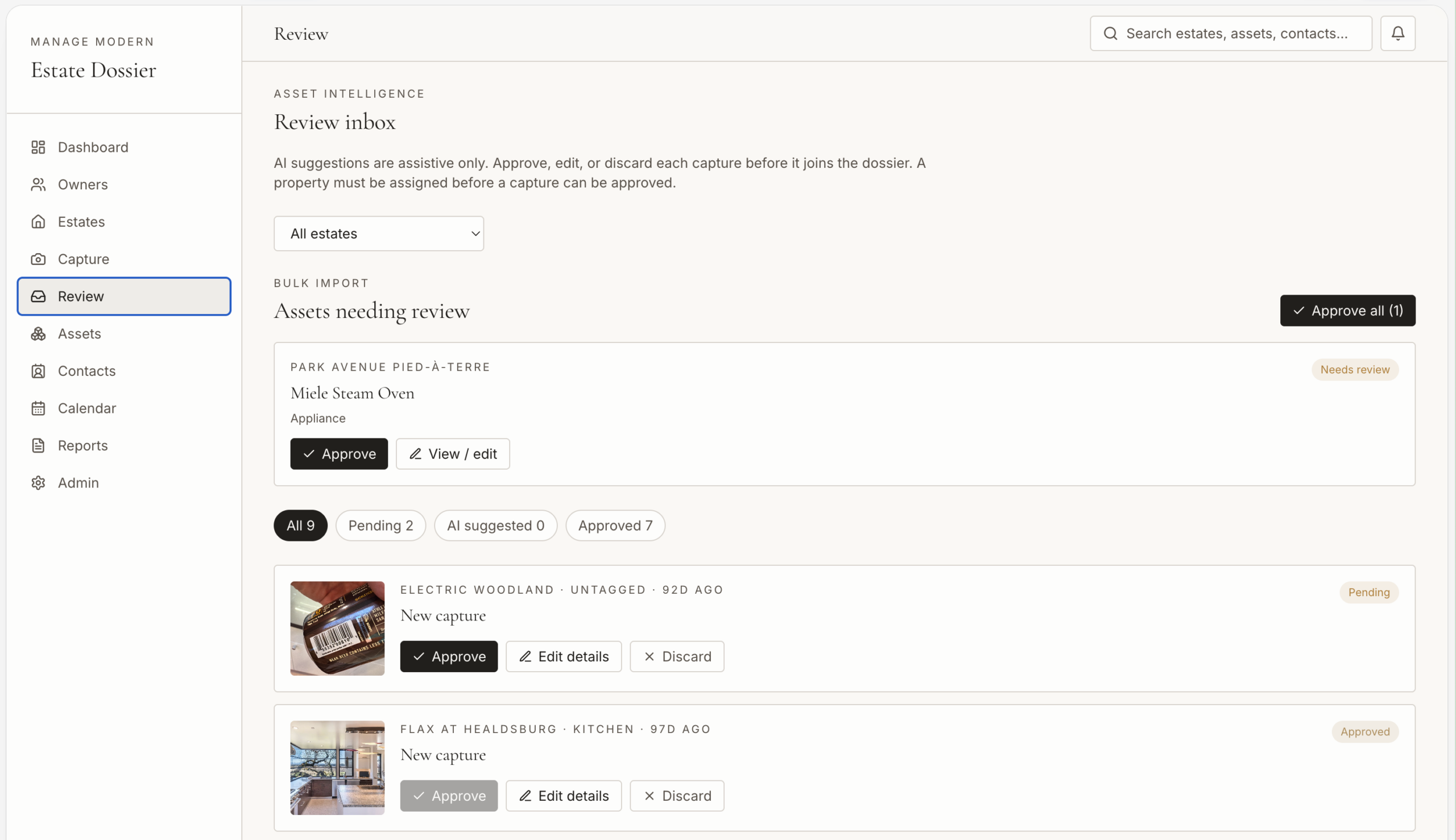
3. Reducing an over-engineered upload-review process
The early prototype also proposed a detailed review process for uploaded images and data. The pattern was intended to create governance, but it introduced too much friction for routine intake.
Not every uploaded photo, document, or data point should trigger the same approval workflow. A process that treats all information as equally risky can make the product feel bureaucratic, slow, and difficult to use.
The issue
Severity: Major — Disproportionate workflow complexity
The upload flow introduced manual review requirements that were not justified by the typical risk or importance of routine information intake.
The standard
Controls should be proportionate to the consequence of an action.
Routine uploads should generally be:
-
Fast to complete
-
Attributable to the person who added them
-
Easy to edit, replace, or remove
-
Organized with lightweight metadata
-
Reviewable later when needed
Stronger review and approval controls should be reserved for genuinely sensitive, consequential, or shared information.
The correction
I simplified the workflow around direct upload, minimal required metadata, clear ownership, and the ability to review or edit information later.
The revised concept preserved stronger controls for cases where they mattered—for example, sensitive personal documents, information shared across multiple stakeholders, or changes that could affect important responsibilities. But it removed broad approval requirements that would have slowed everyday use without adding enough value.
This reduced friction while retaining the right level of trust, traceability, and governance.
What the work demonstrates
The Estate Dossier project illustrates a practical truth about AI-assisted design: AI can create credible first-pass patterns, but it does not inherently know which patterns fit a particular domain, support a product’s long-term model, or deserve the complexity they introduce.
The outcome
The work established a more credible V1 foundation for Estate Dossier.
Rather than optimizing only for rapid feature generation, the product direction balanced immediate usability with the structures needed to support a longer-term roadmap. The resulting approach was more focused, easier to understand, and less likely to accumulate design or technical debt as the product evolves.
The goal was to apply the level of review that makes AI-assisted work genuinely useful:
Determine what is valuable, identify what is fragile or distracting, and document the corrected approach before an early prototype becomes an expensive constraint
Screenshots from early prototype