
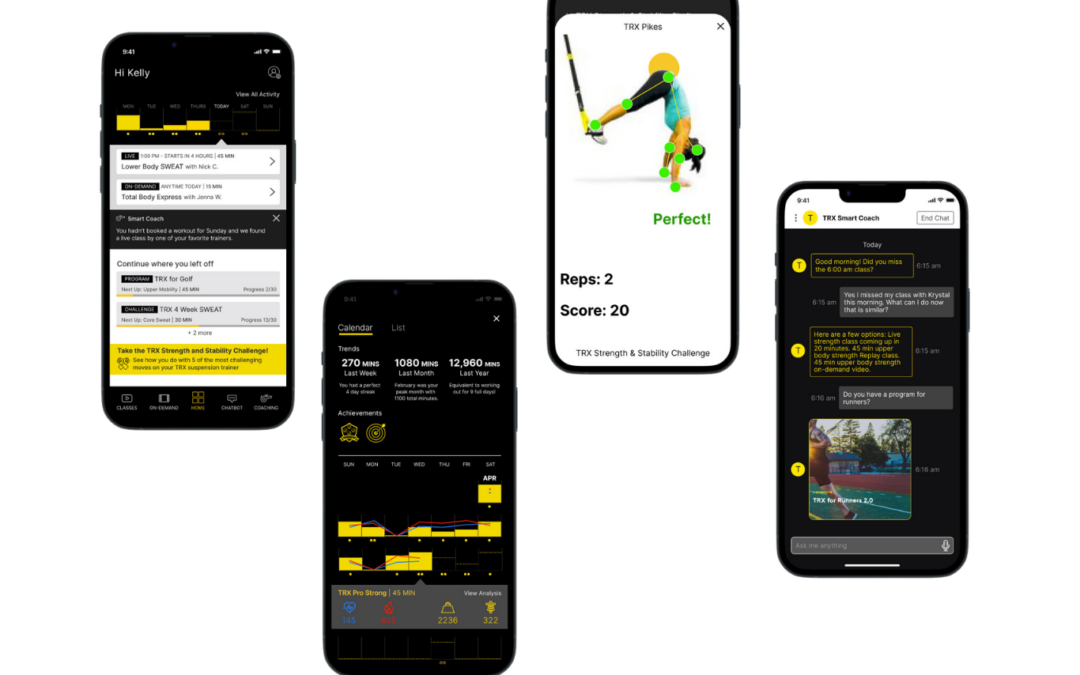
TRX had a strong brand, respected equipment, and a large library of training content. The opportunity was to make its Training Club app more than a destination for workout videos—to turn it into a trusted, personalized fitness companion.
My work with TRX defined a near-future product vision, AI-enabled coaching model, and phased roadmap for evolving the app. A key part of the engagement was evaluating third-party large-language-model outputs related to TRX training, then using those findings to define where the TRX app could deliver more accurate, useful, and brand-specific guidance.
The central principle was simple:
Generic AI can generate fitness advice. A differentiated TRX experience must turn trusted TRX expertise, customer context, workout content, and performance data into guidance that is specific enough to act on.
The challenge
TRX equipment is used in homes, gyms, studios, and training programs, but equipment purchasers were not subscribing to the TRX Training Club at the rate the business wanted. The app’s content experience was not yet fully realizing the value of the TRX ecosystem: equipment, expert trainers, programming, community, and customer data.
The challenge was not merely to add an AI chatbot.
TRX needed to answer larger questions:
- How could the app become more valuable after a customer had learned the basics?
- How could it guide people toward specific goals rather than simply presenting a library of content?
- What kinds of AI-powered recommendations would be credible, useful, and safe?
- What customer, workout, equipment, and third-party data would be necessary to make recommendations meaningfully personal?
- How could the business move toward an ambitious AI-enabled future without trying to build every capability at once?
My role
I guided the product vision and design strategy for a reimagined TRX Training Club experience.
My responsibilities included:
- Conducting landscape and trend analysis across AI-enabled fitness, connected equipment, personalization, computer vision, and digital coaching
- Evaluating third-party LLM-generated responses to TRX-related training questions
- Identifying where generic model outputs were useful, incomplete, insufficiently contextual, or poorly aligned with the TRX training approach
- Defining product concepts and interaction patterns for a TRX Smart Coach
- Creating a North Star vision prototype and strategic roadmap
- Translating the vision into phased product capabilities, from foundational improvements to more advanced AI and connected-fitness features
- Using the prototype and roadmap to align stakeholders, partnerships, and product-development conversations
The resulting vision repositioned TRX Training Club from a content-delivery app to a “Smart Coach” experience built around three strategic pillars: Content, Coaching, and Connection.
The opportunity
The proposed future state was a coaching companion that could help people:
- Set and pursue fitness goals
- Discover the right TRX and non-TRX workouts
- Receive recommendations based on their goals, behavior, and available time
- Build routines and adapt plans when circumstances change
- Learn how to use equipment effectively
- Track progress across TRX activity, connected equipment, wearables, and other fitness data
- Access guidance that felt informed by TRX’s distinctive training expertise
The vision recognized that the market was moving toward connected equipment, wearable data, AI-guided programs, and increasingly personalized fitness experiences. But it also acknowledged a common customer problem: more data does not automatically create more value. Customers need help interpreting their data and deciding what to do next.
Evaluating third-party LLM outputs
At the time, third-party LLMs could respond to a wide range of fitness questions. For example, a user might ask for help preparing for a sport, improving mobility, preventing injury, selecting a workout, or adapting a missed class.
Those responses could sound confident and plausible. But a senior product review revealed important gaps.
The evaluation question
Could a generic LLM provide advice that was useful enough to serve as a trusted fitness coach inside the TRX experience?
The answer was: not on its own.
Generic models could offer broad training recommendations and conversational responsiveness. They did not inherently understand the customer’s TRX equipment, training history, fitness goals, content library, available time, physical constraints, instructor preferences, or recent workout behavior.
That distinction shaped the product strategy.
What the review revealed
| Evaluation area | Common limitation of generic LLM output | Product implication for TRX |
|---|---|---|
| TRX-specific knowledge | Advice could be broadly fitness-oriented but not reliably grounded in TRX methods, equipment, classes, or instructional content | Ground recommendations in vetted TRX content, training knowledge, and approved program structures |
| Personal context | Responses lacked a reliable view of the user’s goals, history, equipment, schedule, or recent activity | Build a profile and activity layer that gives the coach relevant context |
| Actionability | Advice often remained generic: helpful in theory but disconnected from a specific workout a user could start | Connect conversational guidance directly to classes, programs, playlists, and next-best actions |
| Progression | Generic outputs could recommend a workout, but could not reliably adapt an ongoing plan based on performance and progress | Create a phased personalization engine that learns from goals, completion, feedback, and connected data |
| Trust and safety | Fitness guidance needs appropriate boundaries, especially around injury, pain, form, intensity, and individual limitations | Define clear scope, escalation behavior, and evidence-based TRX guidance rather than treating the model as an unrestricted expert |
| Brand differentiation | A generic chat interface is easy to copy and does not create a distinct product advantage | Make AI a delivery mechanism for TRX expertise, content, equipment, and coaching—not a novelty feature |
The important finding was that conversational AI had value, but only when it was integrated into a broader product system.
A chatbot without trusted content, user context, and clear next steps would be an attractive demo. A Smart Coach connected to the TRX ecosystem could become a meaningful reason to subscribe.
Designing the TRX Smart Coach
The Smart Coach concept was designed as an AI-enabled layer within the app, not a standalone feature.
It could support several types of customer needs:
- Finding a workout that fits a specific goal, available time, skill level, or equipment setup
- Recommending an alternative when a live class is missed
- Helping a user choose a program for activities such as running, golf, strength development, mobility, or recovery
- Creating a personalized playlist from available TRX content
- Supporting trainer matching or private-coaching pathways when automated guidance was not sufficient
- Using data from connected equipment, wearables, and workout history to make future guidance more relevant
For example, rather than responding to “I missed my class—what should I do now?” with general exercise advice, the TRX Smart Coach could identify the missed class, understand the user’s goal and preferences, and offer specific alternatives from the TRX library: an upcoming live workout, an appropriate replay, or an on-demand class with similar duration and training focus.
That is the difference between a generic answer and a product experience.
From data to action
The design vision emphasized a hierarchy of value:
- Data — A raw fact, such as a heart-rate maximum or number of completed repetitions.
- Information — Organized or visualized data, such as a weekly performance trend.
- Knowledge — Context that helps a user understand what the information means.
- Insight — A recommendation that helps the user decide what to do.
- Wisdom — Guidance grounded in experience, judgment, and the person’s specific situation.
TRX could create a stronger customer relationship by moving beyond displaying activity data and toward delivering useful, timely guidance.
For instance:
- Data: “Your maximum heart rate was 155 BPM.”
- Information: “Your average effort was higher than similar recent sessions.”
- Insight: “Your pace increased, but your recovery time was longer than usual.”
- Action: “Keep the same load next session and extend rest intervals to remain in your target zone.”
The product opportunity was to combine TRX’s training expertise with customer context and connected data to make this level of guidance accessible at scale.
Product design principles
The vision established several principles for AI-enabled product development.
AI must improve a real decision
The product should not surface data, recommendations, or conversation merely because it can. Each interaction should help the customer choose a workout, adapt a routine, understand progress, or take an appropriate next step.
Context determines usefulness
A useful recommendation depends on the customer’s goals, current plan, available equipment, training history, schedule, preferences, and recent activity. AI without context is generic; AI with the right context can feel like coaching.
Content must be discoverable and actionable
A large content library creates value only when customers can find the right content quickly. Search, filtering, personalization, clear metadata, and contextual recommendations were foundational—not secondary—to the future Smart Coach experience.
AI should be grounded in TRX expertise
TRX’s value was not simply that it could offer another conversational interface. Its advantage was the combination of established training knowledge, recognized trainers, equipment-specific guidance, programming, and customer relationships.
The roadmap must earn complexity
Computer vision, form analysis, connected equipment, external-data integrations, and hyper-personalized programming were compelling future opportunities. They were not all V1 requirements.
The roadmap separated foundational work from more ambitious capabilities so the team could improve the current app while building toward a differentiated future.
The roadmap
The vision outlined a three-phase evolution.
| Phase | Product focus | Key capabilities |
|---|---|---|
| Phase 1: Condition | Improve the existing app experience and establish the foundation for future intelligence | Content discovery, targeted programming, workout planning, basic goal setting, recommendation engine, basic insights, chatbot, heart-rate integration, health-data connections, connected-strap integration |
| Phase 2: Compete | Increase engagement and establish TRX as an ongoing fitness companion | More personalized programming, challenges, richer analytics, notifications, badges, deeper recommendations, evolving chatbot, virtual-private-trainer MVP, trainer scheduling and communication |
| Phase 3: Conquer | Make TRX a central hub in the customer’s health and fitness ecosystem | Advanced Smart Coach capabilities, deeper personalization, computer-vision form analysis, virtual coaching, connected equipment, third-party fitness integrations, community, and intelligent in-app commerce |
The phased plan made it possible to pursue an ambitious vision while grounding early investment in improvements to conversion, retention, engagement, discoverability, and customer value.
What this work demonstrates
This project was not an exercise in adding AI to a fitness app. It was an evaluation and product-design effort focused on defining what AI needed to do—and what systems needed to exist around it—for the experience to be credible.
| Challenge | Design judgment applied | Result |
|---|---|---|
| Generic LLM answers sounded helpful but lacked TRX context | Evaluated outputs for specificity, accuracy, actionability, product fit, and user value | Defined the need for TRX-grounded coaching rather than a generic chatbot |
| A large workout library was difficult to navigate | Connected content strategy, metadata, search, filters, and recommendations | Positioned content discovery as a prerequisite for personalization |
| Fitness data could become overwhelming | Distinguished raw metrics from actionable insight | Designed toward contextual guidance rather than passive dashboards |
| Advanced AI and connected-equipment concepts were compelling but complex | Evaluated capabilities against feasibility, user value, and roadmap dependency | Created a phased path from foundational product improvements to advanced Smart Coach features |
| TRX needed a stronger reason for customers to subscribe and stay engaged | Linked AI features to the core customer journey and TRX’s proprietary strengths | Reframed Training Club as a coaching companion rather than a video library |
The outcome
The North Star vision prototype, strategic narrative, and roadmap gave TRX a coherent direction for evolving Training Club into an AI-enabled fitness platform. The materials were used to support stakeholder alignment, partnership discussions, and product-development planning.
More importantly, the work clarified a product principle that remains relevant as AI capabilities accelerate:
The value of AI is not the ability to produce an answer. The value is the ability to provide the right guidance, grounded in trusted expertise and meaningful context, at the moment a customer needs to act.
For TRX, that meant moving beyond content delivery toward a product experience that could help every customer train with more clarity, confidence, and continuity.