
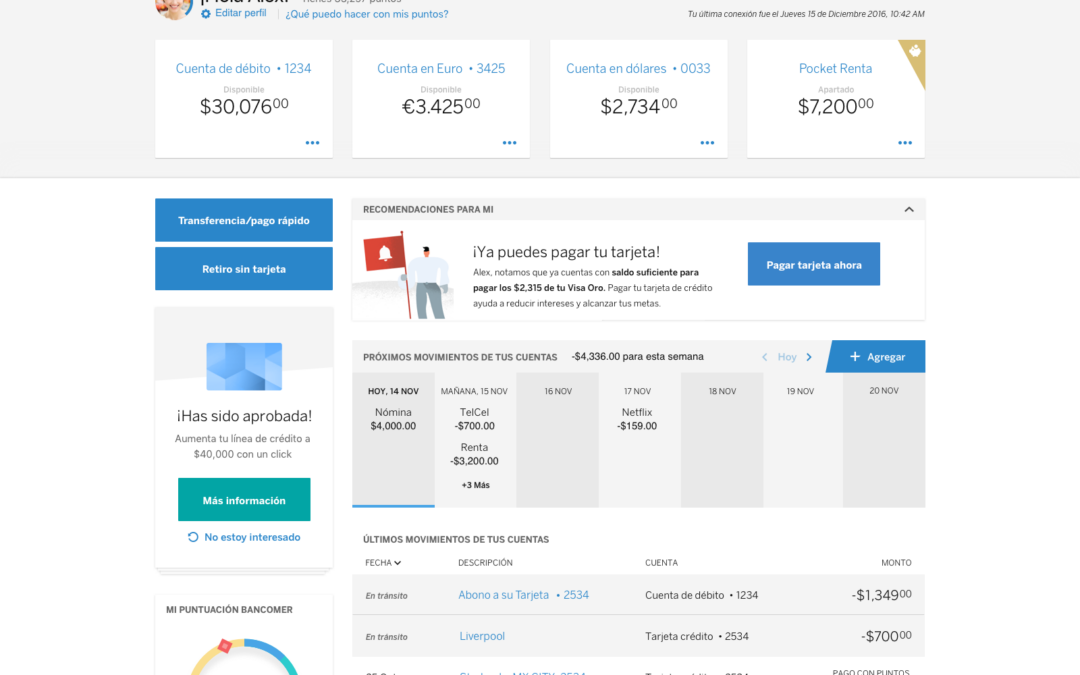
Personalization can make digital banking more useful—but financial guidance is not like a product recommendation or a content suggestion.
When a bank uses a customer’s financial information to offer advice, the experience must earn trust. The advice has to be relevant, timely, understandable, and appropriate to the customer’s situation. It must also avoid the opposite failure: feeling invasive, presumptuous, or overly automated.
My work with BBVA combined two related challenges:
- Create a modular online-banking design system that could serve common customer needs across 11 markets while allowing for local variation.
- Explore how personalized, AI-enabled guidance could help customers make better financial decisions without undermining trust in the bank or creating concern around the use of sensitive financial data.
The result was a product direction that treated personalization as a design and trust problem—not simply a data or technology feature.
The challenge
BBVA’s banks in 11 countries faced similar digital-banking needs, but each market had its own product requirements, customer expectations, and local operating realities.
The immediate design challenge was to create a modular online-banking system that could meet approximately 80% of shared user needs while enabling local teams to adapt the remaining 20%.
At the same time, the organization was exploring the potential for more personalized financial guidance. The question was not whether a system could analyze banking data. The real questions were:
-
Would customers trust the bank to use their financial information in this way?
-
What types of advice would feel helpful rather than intrusive?
-
Which moments in a customer’s journey created a legitimate reason to offer guidance?
-
How could the experience communicate why a recommendation was being made?
-
Where should the product support a decision, and where should it avoid overstepping?
These questions were especially important because banking information is deeply personal, and advice can influence consequential customer decisions.
My role
I led work across customer research, UX design, systems design, prototyping, and strategic narrative.
My responsibilities included:
-
Guiding a modular online-banking design system for use across 11 BBVA markets
-
Facilitating research into customer trust, expectations, and concerns around personalized financial advice
-
Exploring which types of guidance customers considered relevant and credible
-
Identifying the moments when customers would be most receptive to advice
-
Translating research findings into product concepts, interaction patterns, and design-system implications
-
Helping align teams around a common approach to scalable customer experiences and localized implementation
-
Supporting the transition from vision and prototype work into product-development decisions
The opportunity
Traditional online banking often presents customers with balances, transactions, account details, and static product information. It gives them access to data but leaves much of the interpretation and decision-making to the customer.
The opportunity was to make the banking experience more useful by helping customers understand:
-
What has changed in their financial situation
-
What action may be useful or urgent
-
Whether they are progressing toward a goal
-
Where they may be at risk of a fee, missed payment, low balance, or other avoidable issue
-
Which financial products or behaviors might better support their stated priorities
The design challenge was to turn personal financial data into relevant guidance while retaining customer agency and trust.
Researching trust in AI-driven advice
Customer research focused on the emotional and practical conditions that determine whether personalized guidance is welcome.
The finding was not that customers wanted constant advice. They wanted help that felt earned.
Customers were more likely to trust guidance when it was:
-
Clearly tied to information they recognized and understood
-
Relevant to a current goal, recent behavior, or imminent decision
-
Specific enough to be useful, but not so directive that it felt controlling
-
Transparent about why it was being presented
-
Easy to ignore, dismiss, or explore further
-
Framed as support for the customer’s decision—not a demand or sales pitch
-
Consistent with the bank’s role as a trusted steward of sensitive information
Customers were less likely to welcome guidance when it appeared disconnected from their immediate needs, surfaced without explanation, felt overly promotional, or implied that the bank was monitoring every detail of their financial life.
That research reframed the work. Personalized advice had to be designed as a permission-based, contextual experience.
Defining appropriate advice
Not all advice carries the same level of sensitivity or risk. The team explored a range of guidance types and the conditions under which each would be appropriate.
This framework helped distinguish assistance from intrusion. It also provided a practical basis for deciding what should be automated, what should be explainable, and what should remain a human-advisor conversation.
Designing for the right moment
Personalized guidance is only useful when it arrives at a moment when the customer can understand and act on it.
The work examined several moments where advice could have a legitimate role:
-
When a customer logs in and a meaningful change requires attention
-
During a transaction or payment flow, before an avoidable consequence occurs
-
After a pattern becomes clear enough to support a useful observation
-
When a customer is reviewing spending, savings, or progress toward an explicit goal
-
When a customer has missed a payment, encountered an unexpected event, or needs help recovering
-
When a customer asks a question or expresses an intent that signals they want help
The key was not to make the dashboard louder. It was to make the advice more situational.
For example, a generic prompt such as “Explore ways to save more” may be easy to dismiss. A contextual message such as “Your utility payment is scheduled tomorrow, and the available balance in this account is below the amount you typically maintain” provides a clear reason for appearing and gives the customer an opportunity to act.
Product design principles
The exploration established several principles for trusted financial guidance.
Advice must be explainable
Customers should understand the basis for a recommendation. If a product cannot communicate why it is surfacing a message, it should question whether the message belongs in the experience.
Timing is part of the product
Even helpful advice can become irritating or alarming when it appears at the wrong moment. Guidance should be connected to a decision, a meaningful change, a stated goal, or an opportunity to prevent a negative outcome.
Customer control protects trust
Customers need the ability to explore, defer, dismiss, adjust preferences, or seek human support. Personalization should feel like assistance, not surveillance.
Guidance and sales must remain distinct
A product recommendation may be appropriate, but it should not masquerade as neutral financial advice. The experience should clearly distinguish educational support, risk alerts, personalized insights, and commercial offers.
The system must support consistency at scale
If personalized guidance is introduced across markets, the underlying patterns for explanation, timing, escalation, preference management, and user control need to be coherent. The modular system made it possible to define those patterns centrally while allowing local teams to adapt them responsibly.
Building a scalable system
The broader design-system work created a common foundation for digital banking across BBVA’s country operations.
The system was designed to support around 80% of shared user needs across 11 markets, while allowing local teams to address the remaining 20% based on market-specific requirements.
This approach was especially valuable for personalization. A bank can only introduce trusted guidance at scale if core interaction patterns remain consistent:
-
How an insight appears
-
How customers understand its basis
-
How a recommendation links to an action
-
How customers manage preferences
-
How exceptions and higher-risk scenarios are handled
-
When the experience escalates to a human advisor
-
How local teams adapt language, products, regulations, and market conditions without undermining the underlying customer experience
The design system was not simply a library of interface components. It was a way to create shared standards for decision-making, implementation, and customer trust.
The outcome
The BBVA system work improved the organization’s ability to move product ideas into implementation across markets.
During a roadshow, BBVA Mexico identified a feature it had been unable to implement for 18 months. The modular approach resolved the challenge, leading Mexico to adopt the broader system and launch the feature within three months.
The work also established a more thoughtful basis for personalized banking experiences. Rather than treating AI-driven advice as a generic feature, the concepts emphasized the conditions that make guidance worthy of customer attention:
-
It addresses a meaningful customer need
-
It appears at an appropriate moment
-
It is grounded in understandable information
-
It respects the sensitivity of financial data
-
It preserves customer choice
-
It knows when a human advisor is the better next step
What this work demonstrates
The core lesson
In financial services, personalization is not valuable because a system can analyze data. It is valuable only when customers believe the guidance is relevant, understandable, respectful, and in their interest.
The goal was not to make online banking more automated.
It was to make it more trustworthy, more useful, and better able to help customers act with confidence.